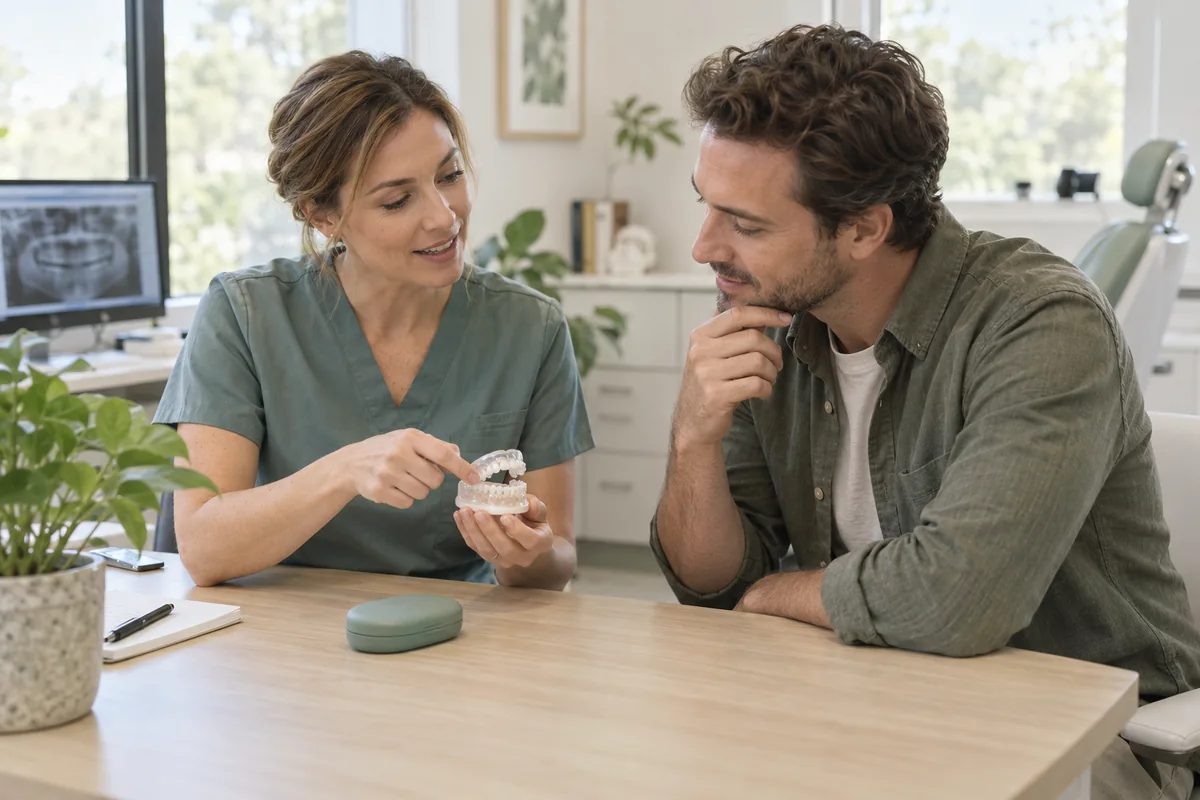
What does “custom” mean when you buy a mouthpiece?
The word can describe two different experiences. A dentist-made appliance involves professional assessment and a device fitted for your mouth. A retail “custom-fit” mouthpiece may instead be a standard appliance with material you soften and mold around your teeth at home. Ask which process the seller means before comparing the prices.
That distinction is about the service as well as the object. Who checks your teeth and jaw? Who helps if the fit changes? Who decides whether an appliance is appropriate? Those questions are especially important when you are choosing treatment for a diagnosed sleep disorder.
Sources: NHLBI: sleep apnea treatment and custom-fitted oral devices
How do the fitting and adjustment options compare?
Separate fit from advancement. Fit describes how the appliance contacts your teeth or tongue. Advancement describes how far a jaw-positioning device brings the lower jaw forward. “Titratable” means the position can be adjusted; it does not mean every adjustable retail device is equivalent to a prescribed custom appliance.
A product can be molded to your teeth but have limited adjustment afterward. Another can offer preset positions without molding. Compare the exact model rather than assuming all OTC products work the same way. Our MAD vs TSD guide explains the underlying mechanisms.
On smaller screens, swipe the table to compare every column.
| Question | Dentist-made appliance | OTC mouthpiece |
|---|---|---|
| How is it fitted? | Professional fitting for your mouth. | Preset fit or home molding, depending on the model. |
| How is it adjusted? | Ask about the prescribed adjustment plan. | Preset levels or a model-specific adjustment mechanism. |
| Who checks the fit? | Your dental care team. | You follow the supplied instructions; ask a dentist when suitability is uncertain. |
| What else should you compare? | Visits, follow-up, repairs and replacement terms. | Support, cleaning instructions and return eligibility after use. |
Sources: AASM/AADSM: oral appliance guideline (2015), SnoreRx: fitting, adjustment and intended use
Does an OTC snoring mouthpiece replace a sleep-apnea appliance?
Do not make that substitution from a product comparison. For adults prescribed an oral appliance for obstructive sleep apnea, the AASM/AADSM guideline favors a custom, adjustable appliance provided by a qualified dentist over a non-custom device. It also recommends dental oversight and follow-up testing. This is guidance for a clinical treatment pathway, not an endorsement of every product sold online.
If you already have prescribed treatment, discuss a proposed change with your treating clinician. If you are unsure whether your problem is simple snoring or sleep apnea, use our sleep-apnea and mouthpiece guide to prepare questions before shopping.
What should a price comparison include?
Ask for a written breakdown rather than comparing a retail checkout total with an unexplained dental quote. For a dental appliance, ask whether the assessment, impressions or scan, fitting visits, adjustment appointments and replacement policy are included. Confirm coverage with your own insurer; do not assume a benefit applies because a product is called a mouthguard.
For an OTC device, check shipping, the exact package, cleaning supplies, replacement costs and the return conditions after molding or use. Our ranked comparison lists retail purchase details, while the Snorple standalone review distinguishes that product from its accessory bundle.
When is a dental assessment particularly useful?
Get advice before choosing an appliance if you have loose teeth, ongoing dental treatment, jaw symptoms or uncertainty about whether the design is compatible with your dental work. A “small,” “soft” or “adjustable” label cannot answer those questions by itself.
If an existing appliance hurts, no longer seats correctly, or seems to change the way your teeth meet, arrange an assessment rather than repeatedly modifying it. The side-effects guide explains the observations worth bringing to that discussion.
Sources: AASM/AADSM: oral appliance guideline (2015), NHLBI: using and caring for an oral device
How can you make the choice practical?
Write down your purpose first: comparing retail snoring products, investigating unexplained symptoms, or discussing prescribed treatment. Next, record the model you are considering, the fitting steps, the available adjustments and the support contact. This keeps a low price or a persuasive review from making the entire decision.
For a retail shortlist, compare two options against the same questions in our mouthguard buying guide. For professional care, bring that shortlist to the appointment and ask which features matter for your mouth. Keep the instructions and follow-up plan with the appliance.
Common questions
Is a boil-and-bite mouthpiece the same as a dentist-made appliance?
No. Home molding changes the fit of a retail appliance. It does not add a dental examination, a prescribed treatment plan or professional follow-up.
Is a teeth-grinding guard the same as a snoring mouthpiece?
The intended functions differ. Do not assume a guard sold to protect teeth from grinding is designed to reposition the jaw or tongue for snoring. Read the intended use for the exact device.
Does a higher price guarantee a better result?
No. Ask what the price includes and how suitability and results will be evaluated. A price or product ranking cannot predict individual comfort or benefit.
Sources & editorial context
Source check completed October 5, 2026. This is an editorial information guide, not an individualized clinical assessment. Manufacturer sources describe products and purchase terms; they are not independent proof of treatment outcomes. Read our editorial approach.