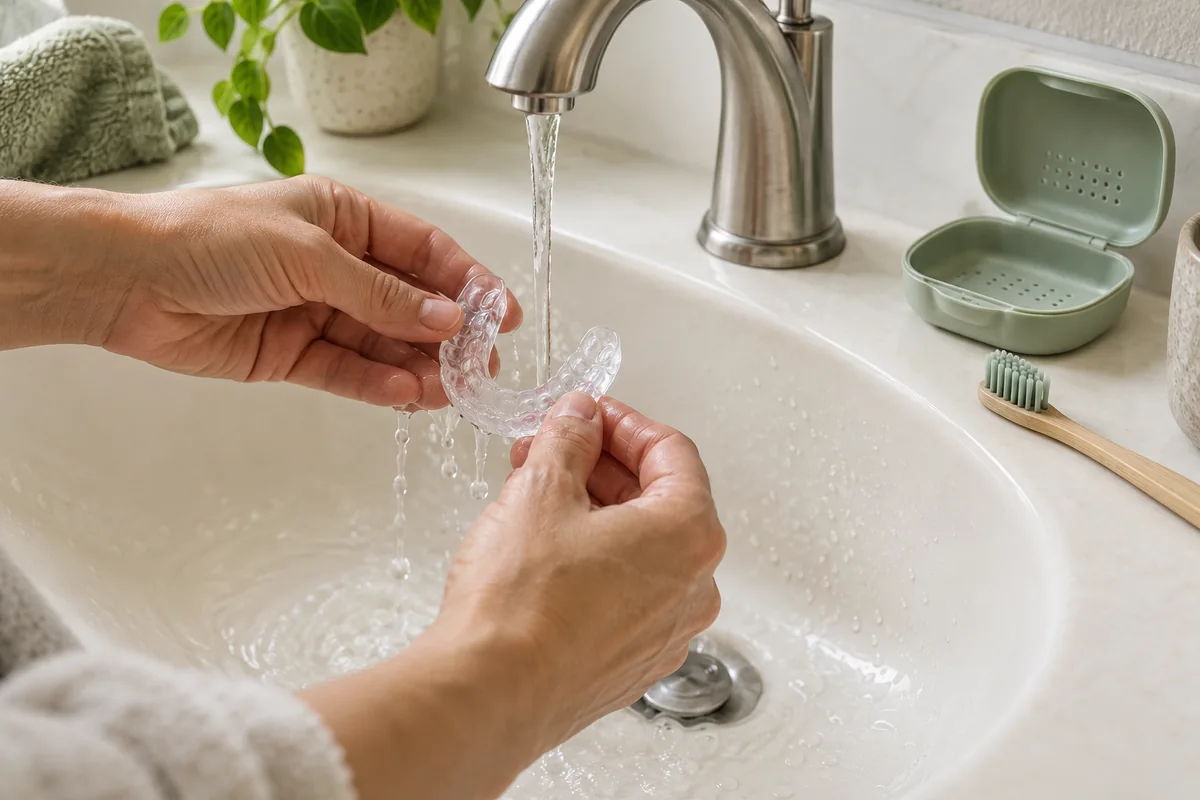
What is a useful everyday cleaning routine?
Start with the care leaflet supplied with your device. A cleaning routine is different from the original fitting process: a temperature used to soften a moldable appliance is not automatically appropriate for daily washing. If your leaflet is missing, obtain instructions for the exact model before choosing a cleaning product.
Use the checklist below to organize the routine. The manufacturer’s directions determine the cleanser, temperature, contact time and drying method. For a dentist-made appliance, ask the practice for its own care instructions.
- Wash your hands, remove the device, and check it for damage.
- Rinse and clean using the temperature, brush and cleanser approved for the model.
- Rinse off the cleaning product as directed; do not extend soaking times by guesswork.
- Dry and store the appliance according to its instructions, and maintain the case too.
Sources: ZQuiet: Comfort mouthpiece care and storage, SnoreRx: use, cleaning and lifespan FAQ, VitalSleep: cleaning, care and longevity FAQ, NHLBI: care and follow-up for oral devices
Can you use toothpaste, soap or cleaning tablets?
There is no single answer across brands. ZQuiet’s Comfort support page allows its branded cleaner or brushing with toothpaste or mild soap. SnoreRx’s FAQ accepts toothpaste but specifically advises against dishwashing soap and several household cleaners. That difference is a reason to check the instructions, not a reason to mix the routines.
A product labeled “denture cleaner” or “mouthguard cleaner” still needs to be compatible with your appliance. Check both sets of directions, including dilution and soaking time. If they conflict, ask the device manufacturer before using it.
On smaller screens, swipe the table to compare every column.
| Manufacturer source | What the guidance says | Practical implication |
|---|---|---|
| ZQuiet Comfort support | Branded cleaner, toothpaste or mild soap; avoid harsh chemicals. | Use the directions for the Comfort model. |
| SnoreRx FAQ | Toothpaste is accepted; dishwashing soap and household chemicals are discouraged. | Do not transfer another brand’s soap recommendation. |
| VitalSleep FAQ | Cool water; approved cleaning options; no boiling after fitting. | Keep routine cleaning separate from molding. |
Sources: ZQuiet: Comfort mouthpiece care and storage, SnoreRx: use, cleaning and lifespan FAQ, VitalSleep: cleaning, care and longevity FAQ
Can you boil or disinfect a snoring mouthpiece?
Do not turn the molding procedure into a daily cleaning step. VitalSleep’s care guidance says not to use boiling water after fitting. A device that depends on a molded shape needs its shape preserved; keep care separate from any manufacturer-authorized remolding.
Avoid a dishwasher, microwave sterilizing cycle or improvised chemical treatment unless the manufacturer explicitly approves it for the model. More heat or a stronger cleaner is not a substitute for an appropriate care method. Read the fitting guide before attempting any refit.
How should you dry and store it?
Follow the model’s directions on drying, case position and ventilation. SnoreRx advises air-drying after use or cleaning. ZQuiet tells users to keep its Comfort mouthpiece flat in the supplied case. A case protects a device only when it is also maintained according to its instructions.
Make storage part of the routine: keep the device with its case, away from children and pets, and do not leave it on a loose tissue that could be thrown away. When traveling, bring the case and an approved care method rather than relying on whatever cleaner is available at your destination.
Sources: ZQuiet: Comfort mouthpiece care and storage, SnoreRx: use, cleaning and lifespan FAQ
When should you replace a mouthpiece?
Check for cracks, tears, damaged connectors, sharp edges or a change in how the device seats. If it is damaged, stop wearing it and contact the manufacturer or your dentist. Cleaning cannot repair a broken hinge or restore an altered shape, and a persistent odor after correct cleaning deserves advice rather than stronger chemicals.
Use the manufacturer’s replacement guidance as a starting point, not a guarantee. SnoreRx estimates roughly six to eleven months but says clenching or grinding can shorten that. Your device’s condition and fit matter more than whether the calendar has reached an advertised lifespan.
Sources: SnoreRx: use, cleaning and lifespan FAQ, NHLBI: care and follow-up for oral devices
What if cleaning is followed by soreness or an odd taste?
Check whether you changed the cleanser, dilution, soak time or rinsing routine, and stop using an unapproved product. Keep the packaging so support can identify what was used. If the appliance causes pain, gum irritation or a concerning bite change, seek advice rather than continuing to wear it while experimenting.
Our mouthpiece side-effects guide can help you describe the problem. For ongoing dental care, bring the appliance and its instructions to the appointment. Good maintenance supports care of the device; it does not establish that the device is treating the cause of your snoring.
Common questions
Does rinsing replace cleaning?
Follow the complete care routine for your model. A rinse is only one step when its instructions also call for brushing or a compatible cleanser.
Can I leave it soaking overnight?
Only if the appliance and cleaner instructions both allow that contact time. Longer soaking is not automatically more effective or suitable.
Can I repair a cracked mouthpiece with glue?
Do not improvise a repair. Stop wearing a damaged device and ask the manufacturer or your dentist about replacement.
Where can I compare the devices mentioned here?
Read the ZQuiet review, SnoreRx Plus review and VitalSleep review for fitting and purchase considerations.
Sources & editorial context
Source check completed October 5, 2026. This is an editorial information guide, not an individualized clinical assessment. Manufacturer sources describe products and purchase terms; they are not independent proof of treatment outcomes. Read our editorial approach.